Showing posts with label Manifesto. Show all posts

Monday, 30 June 2014

Amazon: Best Friend or Worst Enemy?

Bad advice disguised as a how to compete against Amazon article

Vultures circle high overhead.  Stumbling,
struggling, maybe even crawling way down below, we see the cadaverous body of the wholesale distributor.  The experts are once again predicting the demise of distribution.  Unless we heed their costly advice, our lifeless corpse of an industry will be served up as carrion caviar.  And the folks at Amazon will dance a merry jig around our tombstone.

It’s not too hard to imagine the advice these guys are tossing out.  Spend money on building your own e-commerce site.  Hire them or their company to assist you in growing your very own mini-Amazon. 

For our kind of distributor operation, this is a terrible recommendation. 

What is our kind of distribution?
A few years ago I coined the term “Knowledge-based distribution” to describe our type of business.  In this knowledge-based world, we sell a bit of our expertise with every brown box headed out the door.  Depending on the products on your line card, this could be engineering support, start-up assistance, internal logistics assistance, parts kitting or integrated solutions with parts from several manufacturers tied together to solve the customer issue.  We work hand-in-hand with our customers to establish production, maintenance or other long term strategies.  This is a far cry from logistics based wholesalers who basically toss product over the wall to their shipping departments.



If we play the Amazon game we will lose.
Think about this for a moment.  Amazon is investing hundreds of millions into their internet-based platform.  For the purposes of this discussion, we did a quick review of spending for online capabilities.  Amazon didn’t break out their budget, but their biggest competitor in this business, Grainger, reported spending $40 million for online spending in 2012 alone and industry analysts indicate this number for annual spending is going up each year.   If you happen to be a distributor with this kind of budget for e-commerce, you might want to skip the rest of this post.

We’re not saying that fighting an online guerilla war with Amazon, Grainger and the like isn’t a valiant cause.  Instead, I wonder if investing time and energy is a good use of our troops and treasure.  Why not use the effort to up our game in our real area of expertise?  Let’s focus on playing our own game so well that we take business from the giants.

Upping the ante in a game we can win.
Instead of fretting and fumbling with how to improve our online catalog, why not work to develop additional tools for your own unique knowledge-based value proposition?  No doubt your organization provides dozens of value-added services to customers.  Certainly, you provide on-site expertise which will not be delivered via the web (at least in the foreseeable future and my lifetime.)  Let’s invest in the stuff that really attracts our customers.  The list could be massive but here are a few to ponder:

1. Develop a process for measuring the value you provide to customers. 
Don’t count on technical customers to properly monetize the value of your product/service solutions.  Most technical folks lack the basic skills required to turn your last late night service call into dollars produced for their employer.  Develop and aggressively sell this customer advantage.

2. Create connections with your customer’s top brass.
These folks may be writing big checks to your company every month.  Very few of them understand precisely what you do and why you warrant the dollars they send your way.  They don’t understand the technology of your products and most don’t want to learn it.  Why they do want to understand is how you help them make money.  Learn to speak their language; talk about financial impact (see my previous comment.)

3. Build a process around your sales effort.
Good salespeople are hard to find.  Many of your top sellers may be pushing toward retirement years.  A process will help capture their expertise and allow your company to quickly and efficiently on-board the next generation.  And, the future will most likely involve some kind of team sales approach.  Done well, team selling requires a playbook.  A sales process keeps the team running in the same direction.

4. Start charging for some of your services.
A lot of what we do is so valuable, so uniquely positioned and required for customer success that we deserve to be compensated.  The Gross Margin for service model is starting to break down.  Why, because products are getting functionally cheaper and the cost of our expertise is rapidly rising.  Something has to give.  This is where I put in a shameless plug for my book, The Distributor’s Fee-based Service Manifesto.  It’s on… holy smokes, you may have guessed-- Amazon.com.

5. Sell your value to your Supply Partners.
Here’s my take on a lot of this Amazon stuff.  Some of our Supply Partners are reading the same articles I have been subjected to.  A good many of them are starting to wonder if they should be jumping aboard the midnight train to Amazon-land.  We need to stop them at the platform and before they buy the ticket.  The folks who actively sell vendor’s products into new applications aren’t hunched at a computer.  The knowledge-based advice we provide is not buried 300 pages down on some internet site.  We actively sell their products.  We create new demand for their stuff.  All of this effort costs money.  We need a much deeper margin than an online store.

I am not saying we should abandon new customer facing ideas.
Before we get back to the business of distribution, I want to make one final point.  I do believe we should constantly update our ability to interface with customers.  A dynamic website is a must have these days.  Distributors need to be able to handle electronic orders and provide logistical information to customers via e-commerce.  I like electronic invoices.  Mobile apps will play an important role in our near-term future.  Not keeping up is never good.  But….

I believe our game is solving customer problems not selling brown boxes on the internet.

Friday, 9 May 2014

Bite your tongue for saying “free”….


I just had a conversation with an old friend; somebody I worked with back in the 70s.  We were both young Turks on the training program of a major manufacturer. Armed with freshly minted engineering degrees and lots of ambition, we felt we were poster children for “manifest destiny” or at least something like that.  Early on we kept in contact, but then life happened.  And now, after all these years, thanks to the good folks at LinkedIn and unusual last names, we reconnected.

Did someone say FREE SUPPORT?
It turns out we both ended up in distribution.  I asked him to tell me about his business.   Somewhere midway through the description he said, “We are a high service distributor in our market.  We have engineers, highly trained sales people and we provide tons of free support for our customers…”

With mass quantities Starbucks caffeine already surging through my veins, my blood pressure did a flip-flop.  My muscles tightened, the fight or flight instinct kicked, my throat tightened.  I asked if he had seen the title of my new book.  Upon hearing his response to the negative, I gave him a short book review.  Here’s what I said…

For distributors who service the manufacturing and Institutional sector, the landscape has changed dramatically (and continues to change) since we were young pups and the current distribution model was evolving.   Customer companies have downsized, right sized and re-engineered their organizations to run without people.  Over time we distributors have filled the void by providing everything from training and technical support to kitting and JIT inventory services.


In the old days, the gross margin generated from the sale covered the costs of all our “free service.” But forces of technologies have done three things:
1) driven the price of everything down
2) increased the complexity of even low end products
3) provided products that last much longer.


At the same time, the cost of people (60% of the distributor’s budget) has escalated.  Brand new engineers out of school get a median salary of $60,000 (if we use 1977 dollars when we started as a benchmark, engineer salaries have grown 25-30% more than the economy), and they still need to go through the same lengthy training programs we did to be effective.  Exacerbating the situation, the distributor’s supply partners have “pared down and dumbed down” their sales effort relying on distributors to pick up the slack.

This puts our world as distributors on a collision course with catastrophe.

This is not a “how to” book; my experience dictates every
distributor needs to do things just a little differently.  Instead it is a “why you need to change” book; a manifesto.  Like the disheveled and bearded voices from the wilderness before me, I felt compelled to compile my thoughts (and broadcast them to the world).  If you are part of the knowledge-based channel, it’s an easy read.  The kind of book you can pretty much digest on the Delta Flight between Orlando and Orange County.  What’s more, the nice people at Amazon (who may or may not want to put distributors out of business,) will give you a discount on a copy.

Oops, long winded again. I guess it comes from early morning meetings and too much caffeine.

I hope he reads the book. I am pretty sure he will read this blog.  I hope all is well down south.

Wednesday, 5 March 2014

The Lost Art of Value Engineering

As featured in Industrial Supply Magazine online this month. 


I would like to suggest a new term to the lexicon of selling: value engineering. Today, many of the worst and some of the very best salespeople touch up against value engineering for completely different reasons. Let me elaborate.

The worst of sales guys use a low-end form of value engineering. With no real eye for adding new value for the customer, price is their crutch. Armed with the customer’s bill of materials, the price seller searches for discount opportunities. Sacrificing their own margin and that of their suppliers, they look for ways to provide the same stuff at discount prices. Basically, the customer gets a minor discount at the expense of those who actually came to the party with ideas in the first place. In extreme cases, these low-skill sellers suggest lower quality parts without regard to customer application, life cycle needs or improved performance.

The high-end sellers take a completely different approach. Instead of low-quality, low-end part substitution, they take a whole new look at their customer’s efforts. They weigh labor costs against product costs. They take life cycle needs, cost of installation, speed of deployment, ease of making field changes and other points into their equation. They focus more on function than on acquisition costs.

Real value engineering brings more to the customer. Better designs, easier assembly, faster shipping, easier support, quicker set up, smaller investments in engineering, lower cost of ownership and, quite often, lower cost on some of the parts purchased. And, the value can be measured in real terms, like dollars and cents. All of this easily trumps low-end parts at discount prices.


To put this in perspective, here is the definition of Value Engineering from Wikipedia:

Value engineering (VE) is a systematic method to improve the "value" of goods or products and services by using an examination of function. Value, as defined, is the ratio of function to cost. Value can therefore be increased by either improving the function or reducing the cost. It is a primary tenet of value engineering that basic functions be preserved and not be reduced as a consequence of pursuing value improvements.

Value Engineering as a Service
The activities being carried out by some of the worst of our selling colleagues (the substitution of cheaper parts) is purely a sales related activity. And, in my mind, it is a bad one. However, real value engineering is a service; a top-of-the-line service at that.

I believe distributors need to be paid for their services, not only in terms of extra sales and expanded gross margins, but in cash. (If you don’t believe me, read my book, The Distributor's Fee-Based Services Manifesto.) The first step is in professionalizing your service. Talk about your Value Engineering, often. Be able to explain the difference in the service you provide and the parts switching offered by low-end competitors. Measure the effect of your Value Engineering efforts in monetary terms. Share the financial impact of your work to the customer’s management team.

When we work with distributor clients, I am constantly amazed at the real financial impact they bring to their customers (and their supply partners). What’s more, most have convinced themselves that this financial impact is just part of their job. When you build a track record of generating proven results, it’s easier to make a case for being paid for the activity.

A final thought…
Years ago, my boss used to say, “How much will you pay me to make you a million bucks?” We need to ask our customers the same question.

Wednesday, 11 September 2013

Dinosaurs Face a New Reality


Check out the feature in Industrial Supply Magazine to see if your ways are becoming extinct!


If you've read the book, we'd love your feedback!  Feel free to email your thoughts.  Be sure to leave your name and city if you would like your review posted.

Monday, 19 August 2013

Special Delivery

If you've been reading us a while, then you're probably aware of our position on charging for services.  Maybe you didn't know a book was in the works!

So, without further ado, we are pleased to introduce:


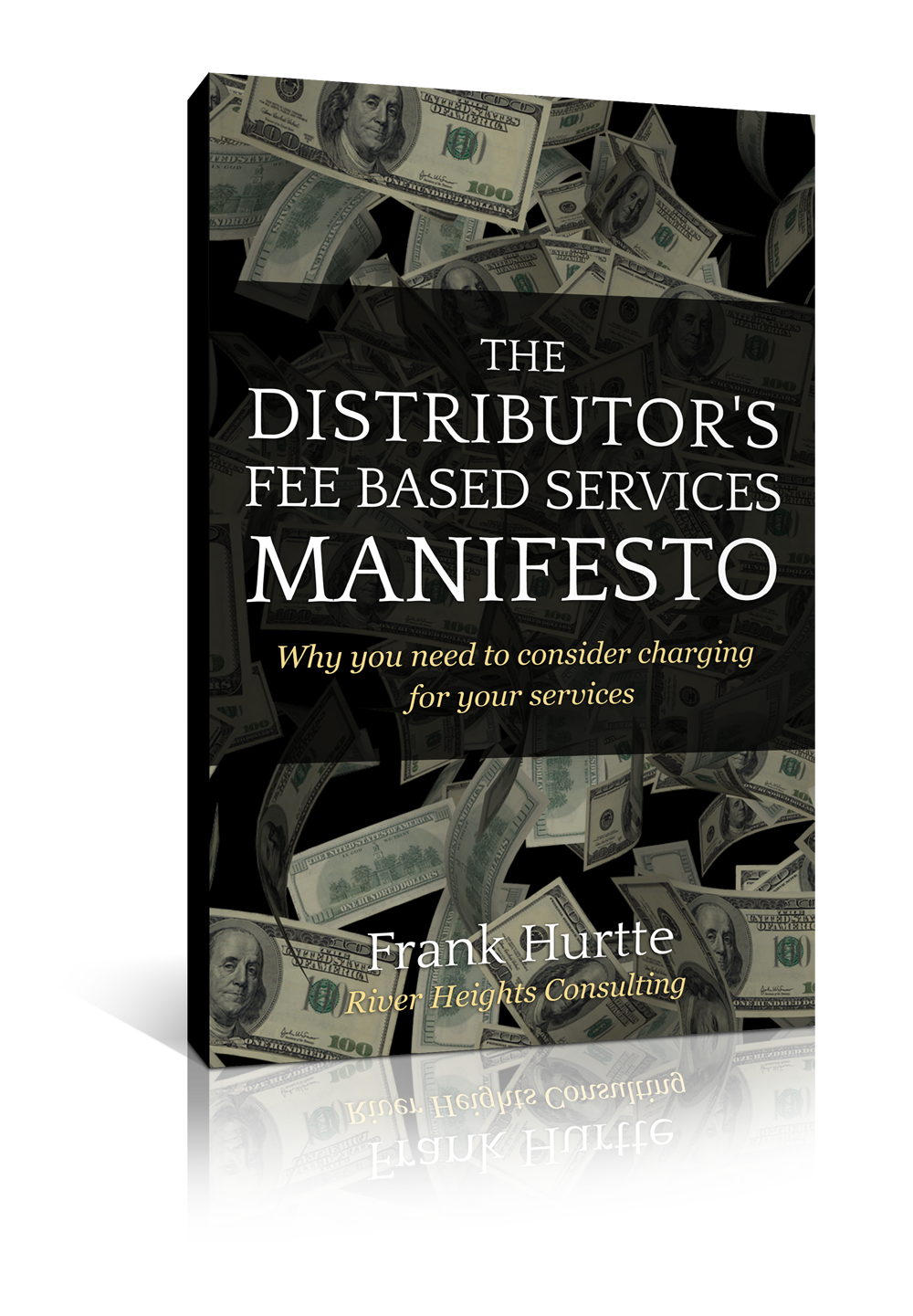
This is The Distributor's Fee Based Services Manifesto by Frank Hurtte.  And because you are reading this, YOU are part of a select group to get a first crack at reading it.  You also get the best price.  Currently listed on Amazon.com for $40, we are offering it to our group members and subscribers for only $20 INCLUDING SHIPPING!   

While there is no catch for this, it would be nice if we could get reviews, good and bad.  You know...in your spare time!

Send $20 payable to Frank Hurtte along with your address to:

River Heights Consulting
Attn: Manifesto
226 Hillcrest Avenue
Davenport, IA 52803

 We're happy to include a receipt for your records.  Let us know if there is a PO number.
This is only good through Labor Day, so put it in the mail today!

Thanks for all the questions, challenges, anecdotes, and support!