Monday, 31 October 2016

Are Brain Hungry Zombies Munching on your Sales Force?

Harboring an ugly gray and decaying complexion, shuffling forward with an unworldly gate, with outstretched arms flailing and uttered chants of “Brains, Brains, must have Brains,” Apocalyptic Zombies trudge down the hallways of distributor sales offices. Brain hungry undead are scouring our buildings for prey.

Surviving on gory morsels of mental morrow called common sense, ever present Zombies have circled the sales group and stand ready to make mincemeat of your team. Unwarily, your salespeople stand in line to “feed” the monsters. They are easy prey. What’s worse, they may not even realize the damage has been done.

Allow me to be your post-apocalyptic tour guide as we look for signs of devastation and learn the proper methods destroying the brain hungry beasts.

Searching for telltale clues to zombie infestation requires a quick eye. Sometimes you have to read between the lines to really understand the extent of the carnage. First, let’s explore the situation with a couple of elementary deductions. You’re an Electrical Distributor, selling products is stock and trade. Along the past few years, you’ve built a value proposition. You don’t just sell products, you sell service and solutions. If you think of yourself as the low service, low price option, I suggest you save yourself about 4 minutes and jump to the last couple of paragraphs. Everyone else, join me as we look at four important clues.


Clue Number One – Salespeople Don’t Really Understand Customers
Job one for solutions-based salespeople is matching products to customer need. A sales guy assigned to an important account should understand basic drivers within the customer organization. The real list would be too lengthy for this discussion, but to give you an idea, here’s a short list:

• How does the customer really make money? For example, does a contractor customer make the bulk of their money on projects or time and material jobs? If the customer is an end user, what is their most important product?

• Is the customer’s organization a private company or part of a larger organization? This matters, especially if you can get information on what’s going on in other parts of the country by way of supply-partners.

• What does internal labor cost the customer? Burdened labor, the cost of keeping a person in the field or the costs of safety equipment associated with each employee is critical information.

• Has the customer identified rejects, scrap or other waste in their system? Assisting in solving issues means understanding precisely how they are measured and being improved.

• Are there critical resources, raw materials or other economic drivers impacting the customer? The cost of energy impacts lots of folks. Precious metals, plastics, Ag commodities and a long list of other items can impact the customer’s think position. A good distributor can help, as long as they know the real situation.


A reasonable person would be building on this list in order to better position the solutions proposed by their company. A thinking person would systematically store this data to share with distributor specialists, trusted supply-partners and others capable of assisting in the sales effort. The trouble is most salespeople don’t. Could it be the result of a late night encounter with a hoard of zombies?

Clue Number Two – Salespeople Don’t Understand the Value of their Work
Ask a “zombie-struck” salesperson to talk about the value of their work and there’s a good chance they will talk about sales growth, commission checks and compensation plans. While these are pertinent, they’re really the byproduct of the real value.

The most important value in their work comes from what they do for customers. Salespeople can talk about value-added efforts for hours. Stories of superhuman customer service flow from their lips. When asked how these really impact the customer’s business, most start waving their hands and get suddenly vague.

The majority of our sellers deliver really strong value to their customers. However, most sellers use a one-size-fits-all approach to customer value. Providing services (that cost them and their employer a fortune) without really understanding the economics can create a massive drain on a distributor’s bottom-line.

As we researched for The Distributors Fee-Based Manifesto, we saw the results of salespeople giving way millions of dollars in free service. Far too often we saw customers with limited or no potential walk away with services their purchases would never justify. To illustrate the extent of the zombie carnage, in many instances sellers have gone “underground” with their activities while hiding the size and quantity from their management teams. Clearly, they know their commitments make little economic sense, yet they still sacrifice company profits for the easy sale. Could a portion of their brain have become a between meal snack for a hungry zombie?

Clue Number Three – Salespeople are Not Calling on the Right People
If brain munching monsters hadn’t been feeding on their minds, salespeople would strive to “cover all the bases” at their accounts. For Electrical wholesalers calling on industrial plants, this means not just calling on purchasing, maintenance and engineering. The sale of our products requires attention in the plant production, the planning department, safety groups and even top level management. The same can be said for contractors and other kinds of accounts. Department names are different but the concept is the same; you’ve got to call on Mr. Big.

To illustrate the point, I got called into a situation where a client thought they were going to lose a million dollar account to a competitor offering a fancy supply contract deal. The competitor had pitched the plan to a corporate Vice-President and was about to scoop the business. The salesperson (we’ll call him Barry,) a guy with 25+ years of experience, joined me and his management team in a Monday afternoon brainstorming session to save this important piece of business. He showed all the signs of zombie damage.

Over the years, Barry had done much to build a relationship with the maintenance team. He helped maintain their inventory, he did regular training sessions, helped troubleshoot and regularly rolled up his sleeves to solve tough problems. Over the 15 years of calling on the account, Barry had done nearly everything right except for one critical point. Barry had never bothered to meet anyone higher up than the storeroom manager. To make matters worse, he had stiff armed his management team’s efforts to build a relationship with the customer’s Mahogany Row folks. Due primarily to this lack of any top level connection, my client spent the next year hustling to maintain a fraction of the account.

It’s neither rocket science nor a new idea. No customer should exist via a single connection. Salespeople must establish a working relationship with everyone critical to the keeping the customer moving forward. The financial guy is probably the most critical.

If Barry’s brains hadn’t been a snack for some undead, he would have reasoned, “This company writes me a check for $100,000 a month. Wouldn’t it be nice if the financial guys knew what I looked like?”

Clue Number Four – Salespeople Who Fail to Build Personal Strategic Plans
This one is easy to spot. Zombiefied salespeople get into routines. To the bitten brain, 2017 will be an extension of 2016. Their formal plan is to somehow magically grow their business through a combination of good luck, deeper customer friendships and fairy dust. When asked if their territory will grow in the coming year, the answer is often based more on management wish lists than their own strategy.

Wouldn’t it be better to have a plan which follows the “who, what, why” approach to sales planning. For those of you who are unfamiliar with the “who, what, why” concept allow me to lay it out.
• Who will provide growth in the coming year? What specific accounts who are poised to grow during the coming year? A salesperson should know enough about their customers’ business to understand how economic conditions will most likely impact them.

• What products or projects will drive the growth? Growth comes from product lines. Understanding which product lines will drive growth allows the sales guy the opportunity to position with supply partners, get necessary pricing agreements, block competition and position themselves with the customer’s upper management.

• Why will the account grow? Check out my points in Clue Number One. Is the account growing because they received the commitment for a very large project? Is a new product picking up momentum and calling for expansion? Was a portion of the plant due for an upgrade? All of these are obviously important throughout the selling process.

Zombies are a Danger Even if You Are a Low/No Service Discount Shop
Hopefully, our four tell-tale clues have provided benefit for distributors selling solutions and customer value. But at the beginning of this article, we promised the other folks (Low/No Service Discount Wholesalers) something to ponder if they jumped over down to this point. Here it is…

It only takes a couple of episodes of the zombie show on TV or just about any zombie movie to realize their bites bites are contagious. Without special care, dumb decisions multiply. The best prevention is ongoing management direction. In a post-Apocalyptic (post-Recessionary) world, we can’t leave them alone and let them sell. According to data presented in The Challenger Sale the difference between the average and top salesperson is growing at breakneck speed. The use of team selling with specialists, application experts and high level customer service resources drives the cost of sale higher. Management must document and measure sales effectiveness and cure the zombie bitten.

Be safe out there...


Monday, 24 October 2016

Are Profit Vampires Sucking Your Blood?

As you relax comfortably reading this article, vampires are plotting a diabolical simple strategy.  Their evil aim: suck the
precious life’s blood from your unsuspecting business.  Like a hungry swarm of vampire bats menacing overhead, they’re everywhere.  And, based on the latest “as seen on TV vampirology”, they can feed for years before they finally finish you off.

Before you start stringing up garlic necklaces for your staff and reading through ancient and musty lore of Transylvanian past, let me say these aren’t physical forms.  Rather, they come in the way of old time myths disguised as modern business practices.  So join me as we talk our way through the vampires in the Industrial Supply Business.

The evil deeds of dastardly fellow, known as Count Purchasing, are legendary.  You could probably add a few anecdotal stories of your own.  But in our world, the greatest disaster to innocents with salesperson business cards comes when Count Purchasing transmutes into the shape of our best friend.

His sweet siren's song goes something like this: “You’re really a great company.  We really think you have worked hard…and because of all this, I am going to let you have the order… Assuming you can match the price.”  To the uninformed, it sweetly rings forth with a too good to pass up message.  At least until you analyze its hidden meaning.


Deep in the cavernous hideout of his castle office, Count Purchasing has an engraved plaque bearing the motto “buy from the best supplier, but pay the price of the worst on the planet.”  In our case, he may be touting the ill-conceived price of that organization down the street.  The one with no post-sale support, poor delivery and terrible accounting practices.  Or in the case of our technology driven products, he may use the price of a company without specialists.  All falling after your motion control, abrasives or cutting tool specialist invested days and dozens of phone calls helping his own engineering team develop detailed specifications, bills of materials and all the rest.  Simply put, you do the work and get paid like the guys who did nothing.

Vampire killing tip Numero Uno, you must recognize that Count Purchasing was trained to sing this verse But wait, there's more.

Another sweet song comes in the form of exaggerated quantities.  “I will be acquiring zillions of these over the next few years.  Give me the price level for your largest quantity break.”  Strangely, the large order never comes.  What’s worse is we, as innocents, often lock their organization into large quantity pricing without setting expectations for lack of quantity or periodically reviewing the results.  Years pass and they continually feed on our goodwill.  Again, a “trick of the trade” is used to pull the life’s blood from our organization.  Vampire killing tip number two; develop quotes that allow for periodic quantity reviews.

Not every vampire in our industry has a cubical down in the
Procurement Department.  Some of them dwell like invisible demons in the minds of our own folks.  When we substitute “nice guy” thoughts in place of business sense, they flourish.  Each and every time we give a really friendly small customer the same pricing as the gigantic user down the street – they put the bite on our bottom line.  Research by David Bauders of Strategic Pricing Associates demonstrates thousands of examples of this phenomenon.  Tiny customers are given sub-market pricing, strangely buying quantities of one or two at levels equal to or lower than your biggest customer who purchases hundreds at a time.  Drop by precious drop the life’s blood of your business is drained from your bottom line.  How much can this be?  These are tiny droplets – but the red cells add up.  David’s team has a track record of adding two points of added margin to distributor’s business.

A trip to the musty crypt of the undead reveals a menacing claw fiendishly refusing to die. 
This monster goes by the name of Free Service.  Let’s bravely explore the situation.  We sold the customer a system back in 2006.  Strangely, a decade later, we find ourselves mesmerized into believing post-sale service is our responsibility.  What’s worse, we think we’re obligated to do it for free.  In spite of expert advice to drive a stake through the beast’s black heart, the darn thing just won’t die.

The practice of free service is a time honored tradition in the electrical wholesaling world.  It is reinforced by some supply partners.  They would have you believe it’s the true duty of every red-blooded prey… I mean distributor.  And systems integrators, contractors and installers echoed the message like sound bouncing in Dracula’s tomb.  For some unholy reason, there’s not an issue with our service, as long as we never, ever charge for the privilege.

Distributors face a growing crisis as our margins are squeezed at exactly the same time as the demand for our services is increasing.  Add the factoid that many of our products are going down in price.  New technology requires even more configurability, and expertise to operate.  Additionally, demographic data eerily screams thousands of highly skilled baby boomers are opting for the sandy shores of some retirement communities.  Their replacements will require even more assistance from our trained people.  And that further complicates our position.

For years, our salespeople have expounded the extraordinary support available through their back-up teams
– specialists, application engineers, project managers and proactive expeditors.  In more than a couple of occasions, I have even heard these guys describe the point that “no sale is ever final” at their company.  Unknowingly they expose their necks and our profits to the hypodermic fangs of this monster.

During the last recession, many of our supply partners “pulled in the reins” by cutting or eliminating manufacturer supported post-sale service and support.  The first time they experienced a 47 minute hold time to have a question answered, customers by the dozens added us to their speed dial.  Still others demanded more from their local distributor when the other manufacturers instituted a fee-based extended support fee.  Either way, we found ourselves on the tooth. 

My own visits to the specialist room across distributor land show more of this highly paid sales resource tethered to their phones rather than out assist in in closing orders.  The problem is, many of them receive positive reinforcement from customer and supply partners alike for this work.  So many have lost sight of their true value, and the revenue creating tasks associated with sales generation.

The Wooden Stake
Bram Stoker gave us Count Dracula.  I can still remember the terror as my 12-year old eyes witnessed Bela Lugosi threatening everything good and pure in that 1931 scary movie classic.  As I left the theater that dark Friday the 13th
night to trudge home with my little brother in tow, I recall the solace of understanding the proper methodology for dispatching a Dracula.  Allow me for a moment to don my very own Professor van Helsing hat and share a couple chapters on vampire killing.

Spend a little time at your next sales meeting talking about negotiation techniques.  A few years ago we worked with purchasing guru Malcolm Mills on a series of sales process improvement programs.  We discovered the guys on Malcolm’s side (purchasing) regularly attend classes covering negotiation strategies.  They don’t lie, but developing skills to mislead our sellers seems to be worth the investment to them.  Every time we stumble into one of their snares, it cost us money.  Insist your sellers answer the comment “your price is too high” with a powerful value statement.

Invest a little time in understanding your value to the customer.  Some of your day-to-day actions create thousands of dollars in real measurable value.  Don’t let Count Purchasing hypnotize you into believing “all our vendors can do that."  First, it’s probably not true.  More importantly, it doesn’t matter.  If you produce real measurable value – it adds to the customer’s bottom line.  You should be fairly compensated. 

Learn the art and science of pricing process.  With tens of thousands of SKUs and thousands of customers, it’s simply too complex to be left to a spreadsheet or manually developed system.  According to our research, a scientifically driven pricing system is the best investment in the distribution business.  If you haven’t already explored the options, sign up for one of Strategic Pricing Associates’ many free seminars.  Even if you do something now, learn about the state-of-the-art in Pricing.

Brainstorm with your salespeople.  Should house accounts be allowed to attend training sessions for free?  Set a policy for time spent with “C” level customers.  Think about this, if a customer generates $2,000 in Gross Margin dollars a year, does it make business sense for your in-house experts to spend a day with this account?  I don’t think so  But it happens; sometimes with good reason.  Could we recoup a portion of the cost?  We need to do something.

Before you venture out into the deafening darkness, before
stepping into the chill of the misty midnight air, beware.  This time the vampires aren’t just a figment of ancient folktale.  They’re real and ready to feed.  Did I mention I have “Holy Water” for sale?


Wednesday, 19 October 2016

How to Recover Unsaved Excel File | Enable AutoRecover Excel File

Hello Everyone, Today we'll discuss a topic How to Recover Unsaved Excel File. This article helps you to know how to recover your whole excel data when you forget to save the file or accidentally close the documents. Just imagine you have been creating a very important document in excel or making a business report and suddenly excel crashed before saving it but you don't need to panic. Microsoft excel has featured in where you can easily Recover Excel Document not saved, just go ahead and read this article. 


Guidelines For Excel File Recovery 

There are some steps to recover your unsaved excel file if you close the file before saving it.
  • Open Excel Workbook then click the File tab.
  • In File tab, click on Recent.

Recover unsaved excel file, Enable AutoRecover Excel File, Recover excel file, Protect  excel file

  • Scroll to the bottom to your recent documents and Click on "Recover Unsaved Workbooks".
  • A dialog box appears, just select the file and open that is temporarily stored in your computer.


Another Method to Recover Excel File

You can also access a file by using these steps:
  • Open Excel Workbook then click the File Tab.
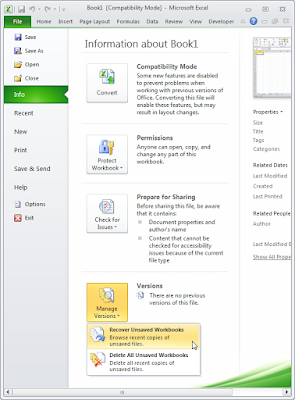
  • In File tab, go to Info.
  • In Info, Click Manage Versions.
Recover unsaved excel file, Enable AutoRecover Excel File, Recover excel file, Protect  excel file

  • Then click Recover Unsaved Workbooks.
  • A dialog Box appears and will see the list of unsaved files then select the file and Open that is temporarily saved on your computer.
  • Then Click on Save As and save the file permanently to your computer.

Enable AutoRecover and AutoSave in Microsoft Excel

There are some steps to enable AutoRecover and AutoSave your excel file so that you can access your file when you forget to save your excel file .
  • Open the Excel  workbook and click the File tab.
  • In file tab, Select Help then Click on Options.
Recover unsaved excel file, Enable AutoRecover Excel File, Recover excel file, Protect  excel file

  • Click Save in the Excel Options dialog box.
  • Now Make sure the "Save AutoRecover information every x minute" and "Keep the last autosaved version If I close without saving" check boxes is selected.

Thus, in this Post, we discussed How to Recover Unsaved Excel File or How to enable AutoRecover and AutoSave in Excel File so that we can easily get our data if we close the excel file accidently. So don't panic if you forget to save your  important data, you can help to recover your data by this information. If you like this information then you can also share with your friends, colleagues and also post on facebook, twitter, Instagram or other social media website. If you find any mistake in this post then you can freely write your suggestion in the comment section so that we can improve our mistake early.

Thursday, 13 October 2016

Non-Price Benefits of a Pricing Process

You see us write a lot about pricing and pricing strategies.  For most distributors, the obvious advantage of a disciplined pricing process is the corresponding increase to the bottom line. Research conducted by David Bauders and Strategic Pricing Associates of Cleveland, Ohio indicates that most
distributors see a margin bump of more than two points. At the same time, examination of the Profit Reports generated by a number of distributor associations indicates the bottom line advantage enjoyed by the “upper quartile” members – those who outperformed 75% of their colleagues - comes from more than “just” a margin advantage.

We discovered these upper-end players were at the vanguard of distributor organizations using Strategic Pricing Associates data driven pricing process. We wanted to explore two points:

What non-pricing benefits/advantages have they discovered as they implemented the SPA process?
How has this migrated into the overall company culture?
We spoke with Jay Johnson, President and COO of Plumbers Supply in Louisville Kentucky, to find the answers.  In his mind, the price related dollars are just the tip of the iceberg. Mr. Johnson went on:

“We believe that our Strategic Pricing Associates based process is a cornerstone in nurturing customer relationships. Consistent pricing builds trust. Nothing is worse for our contractor customers than getting one price today and an unexpectedly different price next week. When a customer experiences this, they begin to question every aspect of our relationship. Things like inventory, service and programs all flash through their minds."

Jay isn’t alone in his feelings about non-price benefits. We interviewed John Wiborg, President of Stellar Industrial Supply of Tacoma, Washington. As we talked about building a pricing strategy, John made this comment:

“The biggest benefits from SPAs disciplined pricing process come in employee morale and service. Let me elaborate. When we centralized the pricing function, it took a lot of the complexity and stress out of our CSRs life. When they (the CSRs) use system price, they don’t need to worry about creating long term customer issues.  It helps them concentrate on the area they typically enjoy most – solving customer issues. When we solve a problem, it makes the customer money. If our price is a little bit more but our expertise creates addition uptime and more customer profit, we feel good. This translates into better customer service where it really counts. Further, our quotes are turned around and delivered faster – customers appreciate that because it allows them to be more efficient. The accounting departments of our customers appreciate accurate billing their invoices. This accuracy has improved the morale of our credit department because they don’t get stuck with disputed invoices that require hours of research and multiple phone calls to correct.”

The Company Culture Piece
Successful distributors simply don’t sell on price. In depth studies of purchasing patterns in segment after segment show price ranked in the fourth or fifth slot. Yet, our sales people repeatedly get “hung up” on this one seemingly low ranked point. And often price moves to the number one spot in their personal hit parade.

Why? I believe it has to do with three basic points:

The uncertainty of price
Metrics like product application features and delivery times can easily be measured and compared. Our competitors provide this information to the public and we can easily measure their widgets against our own.

Human ego
For sales types nothing has the sting of being told, “Your competitor out performed you.” When sales people find themselves on the wrong end of the purchasing decision, they immediately look for something else to blame. Price is a pretty good excuse.

Nice Customers
Regardless of what you read, most people are really nice folks. They don’t want to hurt other people’s feelings (even if they are a quasi-incompetent sales guy,) the human ego is a terrible thing to bruise. Rather than simply say, “I like you. You work for a good company and you seem like a nice enough guy but your competitor out worked you,” it’s easier to convey the message – your price was too high.

Combining this with the human ego above creates an unnatural aura around price.

On the road to building a strategic pricing strategy, distributors face a barrage of pushback not from customers – but from their sales team. But once the process is launched and the sales team witnesses no customer backlash, experiences no loss of business and sees the uptick in gross margin, these sellers start to feel empowered. They savor a new found freedom from the heavy yoke pricing had placed on them.

Distributors with a data driven pricing process, know cognitively and empirically - our price is fair. The data and metrics used along the way give them pricing confidence. It removes a portion of the pressure. A new logic embeds itself into their consciousness. Value is the new game in town.


When sales teams loose an order to a competitor and price is uncertain, there is a strong propensity to blame price and move along. But, take price out of the equation and the self-reflection is directed at a new more meaningful set of evaluations.

Questions like:

  • Is this customer really the type of business best matched to our organization?
  • Did I really understand the customer’s needs?
  • Is something lacking in a component of our relationship?
  • Did my package of values align with the customer’s needs?
  • Did I properly communicate the value provided with the product?
  • Does my competitor offer better product, service, delivery, etc?

These questions drive behavior in a direction that promotes positive human and organizational growth.

Before we go…
Allow me one favor. Go back and review the first question. Research indicates that companies who build a process around targeting customers are 47% more effective in reaching their sales goals. Strategic Pricing Associates is the only organization that provides data rich pricing statistics and a value driven process for improving sales. Targeting is a natural extension. Wouldn't you agree that 47% is a big number?

Tuesday, 4 October 2016

The Future of Knowledge-based Distribution


Earlier this month I was asked to lead a discussion on the future of distribution.  In this case, we focused in on the future of members of the Fluid Power Distributors Association (FPDA).  Since many of our readers are not FPDA members, allow me to provide a bit of background.  The members of FPDA tend to be deeply involved in providing customer solutions.  In many ways they epitomize the knowledge-based distributor.  Their products are complex, sellers understand product technology and application nuances, customers lean on the distributors to provide technical support and most offer up additional fee based services.

Referring to the infographic below and the evolution of the distributor model, FPDA distributors are the poster perfect picture of the Knowledge-based distributor.  Deep product expertise, product specialists, customer centric engineering and solution selling is their mode of operation. 


While the argument for Amazon-like eCommerce may make great sense for the distributors falling into the “Logistics” side of the distribution industry, similar investment on the Knowledge-based side of the evolutionary line is likely to be poorly spent.

A quick survey of those attending the meeting revealed the following statistics:
38 percent of attendees’ companies did zero eCommerce
50 percent did less than 5% of their business via eCommerce
Only 12 percent of attendees indicated eCommerce represented between 11-20% of their sales

Thinking about available resources like time, effort and money, knowledge-based distributors investing in eCommerce do so at the expense/neglect of other potentially more rewarding investment opportunities.  The pressing question is where should a knowledge-based distributor invest?

This question can be broken into four segments:
What customers are best matched for the offering of products, service and knowledge provided by the distributor?
How can the distributor better their ability to drive solutions to this group of customers?
How might the distributor scale up their ability to provide the solutions?
And the most important question of all….
How can the distributor ensure they will be paid for the value they provide?

With all of this in mind, let’s dwell on the critical topic of getting paid for the value provided. 

For this breed of distributor it’s not about value-added sales, instead the crux of the equation is value-metric selling.  Simply put, knowledge-based distributors provide value far above the logistically based guy whose “value-add claim to fame” comes by way of timely deliveries, consolidated invoicing and the occasional cross reference to a more conveniently purchased part.  Instead, knowledge-based distributors provide the stuff needed to help the customer develop better manufacturing processes, reduce costly downtime, reduce rejects and drive profitability.  

Strangely, only a few of the sellers in this high value world really understand the true worth of their actions.  Research indicates, their sellers go the other way, undervaluing what they do.  Instead of measuring the financial impact of their ideas in terms of impact to the customer’s business, they shrug off the economic benefit as part of their “service”; often struggling to justify a percent or two greater margin than the person who provides just products without much needed technical support.  This puts the group in a dangerous position.

As knowledge-based distributors move into the future, their reliance on technical advice, engineering support and turnkey engineered solutions as a competitive advantage deepens.  Demographic shifts point to escalation of human side and other associated costs for the distributor.   Without an understanding of the customer value they create, the distributors will see profitability sag.

Knowledge-based distributors need a different kind of training.  The selling advantage goes to the distributor salesperson who can explain the value of their proposed solution in real customer-centric terms.  It’s no longer acceptable to pepper the conversation in technical jargon and call it good.  Improved cycle times, communication speed, scan rates and other data may be factors for selecting components.  But when a solution is being discussed, the conversation must focus on advantage to the customer.  Going further, customer advantages are best described in financial terms.  For instance, the product feature of improved cycle times, translates into 10 percent more parts generated and that newly created production generates $500,000 additional revenue to the customer.  

While training focused on understanding customer economic value is critical, it must also be understood that rarely are solutions outlined in black and white.  To better understand the situation, let’s explore a hypothetical interaction with the customer.

Acme Manufacturing has an issue with a new machine design.  They would like to employ a robotic arm to properly
locate parts.  The distributor proposes a solution capable of reaching into the machine grabbing the part and properly aligning the part thus eliminating a great deal of human interaction and reducing scrap.  It’s a nice marriage of technology and customer need.  The economics justify the work and the purchase is given the green light.  However, midway through the design stage, the customer asks for a new feature.  Instead of only one positioning action, the robot will require an extra move in order to add a date stamp to the part.  

On the surface, the hardware required to complete the job remains about the same.  But additional engineering is required to make a software adjustment.  And the distributor seller is faced with a dilemma; eat the software cost, avoid conflict and keep the customer happy or negotiate a new price with the customer.

A study of distributors conducted earlier this year, points to a deficit in distributor negotiation skills.  Looking more closely, we have sales teams who constantly negotiate solution and system pricing yet have very little formal expertise in the practice.   

Anticipating questions, allow me to address a couple of points.
Our customers see us a partners and don’t negotiate when dealing with us.  This misconception is rampant in the distributor landscape.  Customers certainly do negotiate as many have had formal negotiation skills training.  Have you ever formalized the technical side of a solution only to be handed off to a purchasing person to finalize the details?  This in itself is a negotiation tactic.
Our sellers have been doing this for years and know how to negotiate.  Selling is typically about knocking down roadblocks to getting the order.  Giving away a little margin, or throwing in some added engineering time is an easy way to close the deal.  Further demonstrating the phenomenon, distributors who run engineering organizations report reoccurring conflicts between those required to generate profits in the technical operation and the salespeople.  Truth is, the sellers are better at negotiating with their co-workers than with customers.
Since our sales team is paid on the gross margin they generate, it’s in their best interest to capture as much gross margin as possible.  From a purely cerebral standpoint, this makes good sense.   However, many salespeople reason that a commission on a small gross margin is better than “haggling over a few bucks” and possibly jeopardizing the order or customer relationship.  Pushing further, antiquated commission policies sometimes encourage sales types to capture less than optimal margins because giving away technical support or engineered services does not reflect on the gross margin number.  In this case, the salesperson gets a commission on bad business. 

What do I recommend for Negotiation Training? 
Over the years I have had the opportunity to sample a number of negotiation skills training packages.  Unfortunately, I have not been impressed.  The big names push tactics over substance.  Most fail to understand that our kind of selling is different.  Distributor-customer relationships are living breathing and ongoing bond.  Every interaction adds to (or subtracts from) the tie between companies.  Tragically, most sellers attending were turned off by the whole seller wins at buyer’s expense mentality.

Thankfully, someone recognized this issue and did something to change the landscape.  SPASigma sprang from
the work done by David Bauders and his Strategic Pricing Associates (SPA) team.  With nearly a quarter century of experience helping distributors apply scientific analytics to their pricing process, SPA has assisted nearly 500 distributors in their quest for developing fair and equitable system pricing.  SPA understands the how distributor business works.  SPASigma has taken a new approach to negotiation training.  Along the way, they have developed a whole system of in-person seminars backed up with online retention tools to assist in changing the outlook of sellers in this field.   You can access SPASigma here

Before we go,
We started off by saying, money spent on eCommerce could be better spent in other ways.  Following this path of skill development centered on understanding your value to the customer, understanding the cost of the services you bundle and negotiation for the best deal will position your company for immediate payback.   Payback capable of funding the future.

Wednesday, 28 September 2016

How to Create a Sparklines In Excel 2010

Hello everyone, Today we'll discuss how to Create a Sparklines or Mini Chart in Excel. A sparkline is a tool/cell  that provides the visual(graphically) representation of data. Excel 2010 Sparklines is used to represent the data (a data which were taken in a rows or column ) creating a new cell (in row or column) and provides the tiny graph for each row or column to analyze the  data and highlights the data values to create a sparklines we need to organize data in a rows or column. It is used to show trends in a series of values, such as seasonal decreases or increases, economics cycles and to highlights a maximum or minimum values of the data.in Excel Sparklines chart have different charts and each chart has its own advantages. This tutorial helps you how to create the sparklines in various types different data and create a chart by using it.


Create a Sparklines | Inline-chart 

Sparklines are small, lightweight graph, that fits into a single cell .when we represent our data in a graphically form or chart form we need to organize data in a rows or column, it is easily understood and it clearly shows the lowest or highest point,economically cycle.here we discuss some point about the chart.So,here we understand how to create sparklines in excel by following some few steps which are:
  • Select an empty cell or rows or column cell  in which you want to show the "Sparkline".
  • Click "Insert" tab. 
  • In the sparkline group, select the sparklines types.
  • A Dialogue box appears, asking for the data range.
  • Click on the icon Data Range and enter the range.
  • Now, click ok.
  • The chart will be shown in the spreadsheet.


  • if you want to show the sparklines in multiple cells, Select the Location range.
  • Click,ok


So, this was all about how to use Excel Sparklines. If you wish to make a sparklines chart that looks different than the simple chart, then after you create the sparklines chart , you can control which data values are points(such as high or low,first or Last and any negative data values). there are many options available .You can do Formatting, add markers, axis etc to enhance the sparklines. Excel sparklines chart allow creating sparklines in the type of Line,Column,Win/LossSo, we will discuss all types of charts and their formatting .


Types Of Sparklines

Line Chart

These Sparklines are displayed in the format of simple lines ,in this data points are connected with lines to see whether a increases or decreases over a time which is easy to read.The line in excel is used to display the trends over time. A line chart is a default option for sparklines,there is no need to specify this as it would be redudant.you could change the sparklines color,markers colors,style of line.To create a line sparklines follow some steps:
  • Select the range of the input data,
  • Click on the insert tab.
  • Select line from the sparklines.
  • Select the data range where you want to insert the Line sparklines.
  • Click  Ok.


  • Highlight the highest point/low point in the chart.
  • Select any color /style from the drop-down list.
  • Get the result.


Column Chart

These sparklines are displayed in the column of bars.If the data which we will enter have a positive value then the bar column will be lying in the upper axis,or if the data consist of negative value then the column will lie below the axis and data have a zero value then column will not be displayed and empty space would be left at the data point and you can change the sparkline color ,style .To create a column sparklines follow some steps.
  • Select the range of an input data.
  • Click on the insert tab.
  • Select column from the sparklines.
  • Select the data range where you want to insert the column sparklines.
  • Click,Ok.
  • Select any color/style from the drop-down list.
  • Get the result.


Win/loss Sparklines:

These sparklines similar to the column but the difference is that these only represent profit/LossIt shows a positive or negative situation of data in a distinctive way. It is very easy to create.
To create a win/loss sparklines follow some steps:
  • Select the range of input data.
  • Click on the insert tab.
  • Select Win/Loss from the sparklines.
  • Select the data range where you want to insert the Win/Loss sparklines.
  • Click Ok.
  • Select the marker color, change the color of negative values.
  • Click on the negative point and select a color.
  • Get the Result.


Conclusion:

Thus, in this post, we discussed How To Create a Sparklines In Excel. Sparklines are simpler  than Charts but not a versatile. Sparklines are the tiny graph that fit into the one cell and gives you the clear graphical presentation of the data. We hope you will like this article, if you like this article then you can share with your friends and colleagues. We will update the information on the regular basis. You can also share this post on social media websites like facebook, twitter, Instagram or other social media websites. If you have any doubt regarding this post you can freely write your query in a comment section. We will revert back to you as soon as possible.

Sunday, 18 September 2016

Targeting Accounts - A Specialist’s Role

I attended a day long distributor planning session, a sales meeting that ended with a “round-robin” planning session.  Vendor salespeople and Distributor Specialists were assigned
tables around the perimeter of the meeting room.  Salespeople spent a few minutes at each table talking about existing opportunities and future targets.  After eavesdropping, I noticed salespeople discussing accounts where they felt additional actions could push the selling process forward. 

Soon after the meeting, it hit me like a ton of bricks. Salespeople knew their assigned accounts but didn’t fully understand the targeting process.  At the end of the day, nearly every salesperson listed the same three or four accounts as their targets – the same accounts and contacts were given for a diverse group of products and technologies.  Later, I asked a couple of salespeople and their managers to define “target” – the results were interesting:
·         “A target account is a new account”
·         “exploratory” 
·         a target should be “one of my top 5 accounts.”

All answers came from the same sales team, same management, attending the same meeting.

Vendor salespeople were no different.  When asked for a “target” for their new product line, one district manager rattled off:  Forest Products, Mining, Food Processing, and Automotive Industry.  Why was this particularly bothersome?  The nearest Forest and Mining businesses were thousands of miles away.   To a salesperson thinking about targets, this sends two messages, “My vendor doesn’t even know a target for my territory” and “this product may not deserve my selling time.” 

Proper targeting is the key to successfully launching new products.  Human nature drives a desire to produce fast results.  Dr. Robert Atkins, inventor of the Atkins Diet, stressed the need for an initial quick success in weight loss to drive future behavior over a long period of time.  Dr. Shinichi Suzuki discovered that children who experienced quick success in music were more likely to continue their
studies, even once practice became routine.  Specialists can drive a result by “stacking the deck” for early success.  This creates the initial one or two wins that build long term success.  Since you are responsible for getting the new products into your company’s sales pipeline, time invested early thinking about targets pays important dividends. 

For each new product answer the following questions:

Which customer types would best benefit from the product?
This should be answered in as specifically as possible.  A bad example would be General Motors – a good answer would be the painting department of a large metal assembly company (General Motors) where explosive paint fumes create the need for tools with special arc proof coating.  This opens the door to thoughts about a number of different companies where the environment is similar.  Vendor partners and nationally based organizations like to use SIC codes to make these decisions.  Unfortunately, the SIC registry is not an exact science.  I suggest you put your personal knowledge and your team’s knowledge, to work in developing a short list.

Who at these companies is most likely to understand the impact of the benefit?
Hopefully your salesperson has multiple account contacts.  Careful thought should be given to selecting the right contact.  If your product has a safety feature, showing it to a maintenance person may prove to be disastrous.  She may judge your product based on it being difficult to use rather than the importance of added safety.  This is as important as selecting the client company.

Do you (or the vendor salespeople) know of companies experiencing success in some other part of the country/territory?  What drove their success?
Nothing can jump start the success of a new product like an introduction to the local plant of a company that has already experienced success.  Before adding these people to your list, it is important to know a few details.  What were the situations leading to the use?  What went well?  What was learned?  How well has this been publicized to the company in general?   Make contact with the key decision maker at the remote location.  Call for these details to make the success story more valid for local users.

Once you have this information and the opportunity presents itself, Specialists can gain buy-in from the salesperson.  Discuss your ideas for quick successes.  Whenever possible, overlay your choices with her own top accounts.  It is easier to sell more to existing accounts.  When you are finished with the initial process you should have the following information:
  • Target Account names: No more than 6
  • The right contact: By name or Title
  • Proper collateral materials: Literature, demos, samples, joint call dates
  • A few specific bullet points to use in selling the product: Remember salespeople have dozens of accounts
  • A mutually agreed upon time frame for initial contact

Targets need to be revisited.  After the salesperson’s first
customer meeting, the Specialist can help fine tune the Targeting process by discussing the high and low points of the call.  If new collateral is needed, it can quickly be brokered to the salesperson.  If the demo didn’t go smoothly, a personal tutorial will rebuild confidence and drive better demos at the next Target.  If this meeting produces major discoveries, i.e. the competition has the same thing at 10% lower price, adjustments can be made for the entire sales organization. 


Targeting accelerates business growth, but is this worth the effort?  Here is a parting thought; new research indicates that organizations who are great at targeting are 47% more effective than those with average targeting skills.  Specialists are uniquely qualified to make an impact!  Good luck and happy targeting.